
Pancha Kosha — The Five Layers of Who You Are
Quick answer: Pancha Kosha means the “five sheaths.” It is yoga’s map of a human being, taken from the Taittiriya Upanishad: the physical body (annamaya), the energy body (pranamaya), the mind (manomaya), the wisdom layer (vijnanamaya) and the bliss layer (anandamaya). Yoga cares for each layer in turn, from the outside in.
Why does yoga talk about layers at all?
Most of us live as if we are only a body with a busy mind attached. Sit by the Ganga at Shivpuri for a few mornings and that idea starts to loosen. You notice that the body is not the same as the breath, the breath is not the same as the thoughts, and something in you is quietly watching all of it.
The rishis noticed the same thing thousands of years ago. They described a human being as a sword resting inside five sheaths. The word kosha literally means a covering. Yoga is the gentle practice of caring for each covering so that the Self within can be felt.
What are the five koshas?
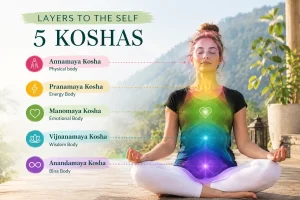
1. Annamaya Kosha — the body made of food
This is the physical body, built from what we eat (anna means food). It is the easiest layer to feel and the best place to begin. When it is out of balance we feel heavy, stiff, tired or restless. Nourish it with fresh seasonal food, enough sleep, and asana practiced steadily rather than aggressively.
2. Pranamaya Kosha — the body of vital energy
Here lives prana, the life force that moves through the breath. When prana is low, we feel drained even after rest. Breath is the doorway to this layer. Pranayama, sunlight, clean air and time in nature all feed it.
3. Manomaya Kosha — the mind and the senses
This is the layer of thoughts, feelings and sensory impressions. Worry, overthinking and mood swings show up here. Mantra, chanting, trataka (candle gazing) and mindful routines calm this layer by giving the mind one steady thing to hold.
4. Vijnanamaya Kosha — the layer of wisdom and discernment
Vijnana is the ability to see clearly: to tell what is true from what is merely loud. It grows through self-study (svadhyaya), reflection, good company and meditation. When this layer is weak we repeat the same mistakes. When it is strong we pause before we react.
5. Anandamaya Kosha — the layer of bliss
The subtlest sheath is a quiet contentment that does not depend on anything outside us. It is glimpsed in deep meditation, in selfless service (seva) and in moments of complete stillness. Tradition does not call this layer the Self itself. It is the finest veil closest to the Self.
How do the five koshas work together?
They are not separate rooms. They are overlapping layers, so a change in one reaches the others. Slow your breath (pranamaya) and the mind softens (manomaya), the muscles let go (annamaya), and clarity returns (vijnanamaya). This is why a good yoga class is never “just stretching.” Many traditional Yoga Nidra practices guide attention through these layers in a single sitting.
A simple 15-minute practice for all five koshas
- Body (3 minutes): Do slow Sun Salutations or gentle neck, shoulder and spine movements.
- Breath (4 minutes): Sit tall and breathe in and out for an equal count of four.
- Mind (3 minutes): Repeat Om silently, or gaze softly at a candle flame.
- Wisdom (3 minutes): Watch your thoughts and ask, “Who is aware of these thoughts?”
- Bliss (2 minutes): Sit in silence. Do nothing. Let whatever peace is available be enough.
Frequently asked questions
What is Pancha Kosha in simple words?
Pancha Kosha are the five layers that make up a human being in yogic philosophy: body, energy, mind, wisdom and bliss. Each layer is a covering of the true Self.
Which kosha should a beginner start with?
Start with the physical (annamaya) and energy (pranamaya) layers through gentle asana and simple breathing. The subtler layers open naturally with steady practice.
Where is Pancha Kosha mentioned in the scriptures?
The five-kosha teaching comes from the Taittiriya Upanishad, in the section known as Brahmananda Valli.
Are koshas and chakras the same thing?
No. Koshas are layers that wrap around the Self, like sheaths. Chakras are energy centres along the spine. Both are maps of the subtle human being, drawn from different traditions.
Experience the five layers at Yogada
Reading about koshas is useful. Feeling them is what changes you. Our Yoga Curriculum shows how philosophy, asana, pranayama and meditation are taught together, and our 200 Hours Yoga Teacher Training Course is the full immersion. If you would like a gentler first step, begin with an Atam Sukha wellness retreat in Shivpuri, or explore yoga in Rishikesh with us.
